

Mother Jones illustration; Michael Brochstein/Zuma; Getty
Last week, the New York Times reported a rare bright spot in public health: The number of children who suffer from potentially life-threatening food allergies has declined sharply since the government changed its guidelines around early exposure to products containing common allergens such as peanuts. Federal guidelines had long recommended that parents avoid feeding babies these products in a misguided effort to prevent allergies.
But in 2017, two years after a large trial found that early exposure to small amounts of the products actually seemed to protect against food allergies, the National Institute of Allergy and Infectious Diseases reversed its previous guidelines. Since then, a new study published in the journal Pediatrics found, the rate of food allergies has declined from about 1.5 percent of all American children in 2015 to .9 percent in 2020, a significant drop of more than a third.
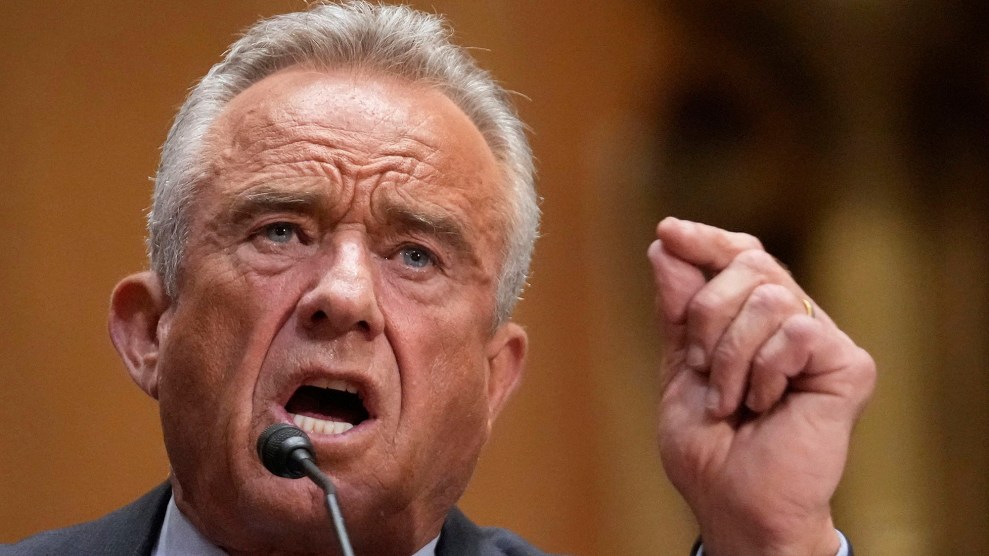
The new findings would seem to complicate a theory, long championed by Health and Human Services Secretary Robert F. Kennedy Jr., that food allergies are caused by small amounts of aluminum present in routine childhood vaccines. During a fireside chat-style discussion about the Make America Healthy Again movement at the National Governors Association’s Colorado summit in July, Kennedy claimed that a group that he had helped found in the late 1990s, the Food Allergy Initiative, had once visited a lab at Mt. Sinai Hospital in New York, where a scientist had told him that a team of researchers had discovered that exposure to aluminum causes allergies.
“I asked the scientist there, ‘How do you induce an allergy in a rat?’ And he said, ‘It’s formulaic. You take aluminum adjuvant and inject it into that rat with a protein. If it’s a peanut protein, that rat will have a lifetime allergy to peanuts. If it’s a dairy protein, you’ll have a lifetime allergy to dairy. If it’s a latex protein, you’ll have a lifetime allergy to latex.’ That’s the same aluminum adjuvant that’s in the hepatitis B vaccine, and many of those vaccines contain peanut oil excipients.”
Curiously, though, a researcher who has been intimately involved in allergy studies at Mt. Sinai told Mother Jones in an email that he wasn’t sure what Kennedy could have been referring to. Dr. Hugh Sampson, a pediatrician who specializes in allergy and immunology, said he came to Mt. Sinai in 1997 to help found the institution’s Jaffe Food Allergy Institute. Dr. Sampson, whose lab used cholera toxins, not aluminum, to study anaphylaxis in mice, said his group had worked with the Food Allergy Initiative and that he recalled seeing Kennedy at Mt. Sinai. Possibly, Kennedy was referring to a different lab, but “I am not aware of any other lab at Mount Sinai that was doing this kind of work at that time,” he wrote.
The addition of aluminum to vaccines has been a longstanding practice by manufacturers, who use it because it boosts the immunization’s effectiveness. The American Academy of Pediatrics guidelines note that “The amount of aluminum in vaccines is safe, regulated, and comparable to the amount of aluminum infants are exposed to through human milk and formula feeding.”
Allergist and social media health communicator Dr. Zachary Rubin echoed those assertions, adding that “research consistently shows that early dietary introduction of allergens, not vaccine avoidance, is what helps prevent food allergies.” Experts’ confidence in the safety of aluminum hasn’t stopped Kennedy from insisting that it be reinvestigated; it’s listed in an October memo on questions to be considered by the Centers for Disease Control and Prevention’s newly reconstituted Advisory Committee on Immunization Practices (ACIP).
“Research consistently shows that early dietary introduction of allergens, not vaccine avoidance, is what helps prevent food allergies.”
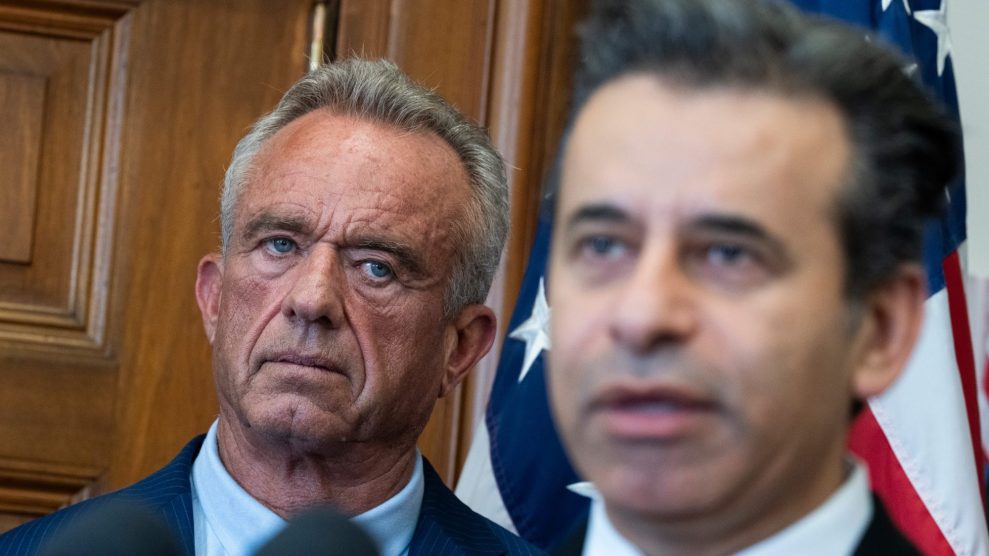
At the Governors Association’s event, Colorado governor Jared Polis pushed back against Kennedy’s claims, citing the lower rate of peanut allergy in Israel, where babies are commonly fed a peanut-based snack as a first food. But Kennedy fired back that Israel’s Hepatitis B vaccine schedule was different. “They don’t give them early in life,” he said. This claim turns out not to be true. Israeli guidelines call for newborns to be vaccinated against Hepatitis B within the first 12 hours of life, the same as in the United States. Neither the US Department of Health and Human Services nor Food Allergy Research and Education, the group that grew out of Food Allergy Initiative, responded to a request for comment from Mother Jones.
In the same Colorado appearance, Kennedy referred to a 2017 study published in the Journal of Translational Science that he claimed further substantiated the link between aluminum in vaccines and food allergies. But that study suffered from poor methodology and dubious provenance: parents of the 666 homeschooled children self-reported vaccination status, and these subjects were hardly a representative sample. The study was funded in part by Generation Rescue, Inc., and the Children’s Medical Safety Research Institute, both of which are anti-vaccine advocacy groups.
The root cause of food allergy is likely complex, but Dr. J. Andrew Bird, a pediatric immunologist and chair of the American Academy of Pediatrics’ Section on Allergy and Immunology, told Mother Jones via email that there is “no credible evidence from high-quality studies that aluminum adjuvants in vaccines contribute to the development of any food allergy, including peanut allergy.”
Rather, Dr. Bird wrote, allergies are thought to be “influenced by factors such as genetic predisposition, delayed introduction of peanut in infancy, and disruption of the skin barrier associated with eczema.” He pointed to a Danish cohort study of 1.2 million children, which found no link between aluminum in vaccines and the development of food allergies.
Kennedy’s interest in food allergies is not new—in fact, it predates his anti-vaccine activism. A 2002 article in the celebrity gossip magazine 15 Minutes described a star-studded “food allergy ball” chaired by Kennedy, who told attendees that his own son was hospitalized multiple times due to his allergies to nuts, soy, and shellfish. The $2.1 million in proceeds from the event, 15 Minutes reported, were to be spent on finding a cure for food allergies. The option they planned to explore? A vaccine.